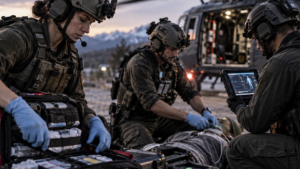
Emergency medicine has always depended on speed, preparation, and the ability to make critical decisions under pressure. Information technology is adding another dimension to that equation. Digital communications, connected medical devices, mobile applications, wearable sensors, cloud-based data systems, and artificial intelligence are beginning to change how emergency personnel receive information and manage care in the field. 🚑💻
The shift is especially significant in environments where conventional hospital infrastructure is unavailable. Military medics, emergency medical technicians, law enforcement officers, disaster-response teams, industrial safety personnel, and remote rescue crews frequently operate with limited resources and very little time. As emergency equipment becomes increasingly connected to larger information networks, trauma care is moving beyond a collection of physical medical supplies toward a broader technology-supported response system.
For IT professionals, this development represents an important intersection between healthcare, cybersecurity, data management, communications, and mobile computing. The future of emergency medicine will depend not only on better medical equipment, but also on how effectively technology can deliver useful information to the people treating patients when every second matters.
Emergency Care Is Becoming a Connected Environment
For decades, field medicine largely operated independently from the information systems found inside hospitals. A responder stabilized a patient, documented the situation, transported the patient, and transferred information to hospital personnel. Digital technology is gradually connecting those stages of care.
Modern emergency response systems can allow dispatch centers, paramedics, emergency departments, trauma teams, and public-safety agencies to exchange information much earlier in the process. That information might include patient vital signs, incident details, estimated arrival times, photographs, treatment records, or environmental conditions surrounding an emergency.
The broader field of health informatics demonstrates how computing and information systems have become intertwined with healthcare. Software, data standards, communications networks, medical devices, and clinical information systems increasingly work together instead of functioning as isolated technologies.
For trauma care, that integration can be particularly valuable. Emergency personnel often operate in environments where decisions must be made rapidly and with incomplete information. Technology cannot replace clinical training, but it can help place useful information in front of trained personnel when they need it.
Smart Technology Is Expanding What a Trauma Kit Can Become
A traditional trauma kit is built around physical supplies such as dressings, tourniquets, gauze, airway equipment, gloves, and other emergency medical components. Those supplies remain the foundation of field trauma care. Information technology, however, can add a digital layer around them.
Future kits could increasingly be paired with smartphones, rugged tablets, wearable devices, portable diagnostic equipment, location technology, electronic documentation systems, and wireless communications.
Organizations purchasing Tactical Trauma Kits are therefore operating in a medical environment that is becoming increasingly technology-driven. The physical supplies remain essential, but their use can exist within a larger network of communications, data, training resources, and medical decision support.
This does not necessarily mean that every medical supply will contain a computer chip. The more practical development is the creation of connected systems surrounding the kit.
A responder might use a mobile device to document treatment. A wearable monitor could collect patient information. GPS technology could communicate the location of a casualty. Digital inventory software could help an organization identify supplies that need replacement. A mobile reference platform could provide approved clinical guidance.
Together, those technologies can create a more informed emergency response environment.
Mobile Computing Is Bringing Information Directly to Responders
One of the most practical developments in emergency technology is also one of the simplest: putting reliable information on mobile devices.
Smartphones and tablets are already familiar tools, which makes them useful platforms for emergency reference materials, communications, documentation, mapping, and decision support. Ruggedized versions can also be designed for environments where ordinary consumer electronics may not be suitable.
The World Health Organization’s Clinical Care in Crises program illustrates the direction this technology is taking. WHO describes a digital platform intended to deliver clinical decision support and established medical guidance to frontline healthcare workers in emergency environments.
That approach has major implications for emergency IT.
Instead of relying entirely on printed manuals, organizations can potentially distribute updated information digitally. Changes can be deployed more quickly, reference materials can become searchable, and applications can be designed around the specific information responders need in the field.
Connectivity remains a challenge, particularly during natural disasters, military operations, and remote emergencies. For that reason, resilient systems capable of functioning with limited or intermittent internet access will remain important.
Wearable Devices Could Give Responders Better Situational Awareness
Wearable technology represents another growing connection between IT and emergency medicine. Devices capable of monitoring pulse, oxygen saturation, temperature, movement, location, and other measurements have become increasingly common.
In an emergency environment, wearable technology could potentially help responders monitor several patients or casualties without relying entirely on repeated manual measurements.
The technology also creates an important cybersecurity challenge.
The National Institute of Standards and Technology’s research on first-responder mobile and wearable devices has examined cybersecurity concerns involving smartphones, tablets, wearables, emergency medical services, fire services, and law enforcement. NIST has emphasized that expanding the number of connected devices available to first responders can also introduce new security vulnerabilities.
That balance will become increasingly important.
A medical device may collect extremely useful information, but organizations also need to consider authentication, encryption, device management, software updates, wireless security, access controls, and the protection of sensitive information.
The smartest emergency technology will need to be both useful and secure.
Real-Time Data Can Improve Coordination Before the Patient Arrives
One of the most promising benefits of connected emergency technology is the ability to move information ahead of the patient.
Traditionally, a hospital may receive relatively limited information before an ambulance arrives. Connected systems can potentially provide emergency departments with earlier insight into the patient’s condition.
Consider a serious accident in which responders are treating multiple injuries. Digital systems could transmit vital signs and treatment information while the ambulance is still traveling. Hospital personnel could then use that information as part of their preparation for the patient’s arrival.
The concept fits within the broader modernization of health information infrastructure.
The Office of the National Coordinator for Health Information Technology’s 2026 Interoperability Standards Advisory addresses interoperability standards used for clinical, public-health, research, and administrative information exchange. Interoperability matters because technology becomes far more useful when different systems can reliably exchange and understand information.
Emergency systems cannot reach their full potential when every device and application operates inside a closed ecosystem.
Artificial Intelligence Could Become a Field Support Tool
Artificial intelligence is likely to become another important part of emergency-care IT, although its role must be approached carefully.
AI systems can process large amounts of information quickly. In emergency environments, potential applications include analyzing sensor readings, organizing incoming incident information, assisting with resource allocation, identifying unusual patterns, translating communications, managing inventories, and supporting documentation.
AI could also help software prioritize information displayed to responders.
A system receiving information from several sensors, for example, might highlight significant changes that deserve attention rather than forcing personnel to constantly review every incoming measurement.
Clinical decisions still require appropriately trained professionals and established protocols. The greatest near-term value of AI may therefore come from supporting responders rather than attempting to replace their judgment.
The most successful systems will likely be those that simplify complex information instead of adding another layer of technology that personnel must manage during an already stressful emergency.
Inventory Management Is Another Overlooked IT Opportunity
Emergency readiness depends heavily on having the correct equipment available when an incident occurs.
That creates a significant inventory-management challenge for police departments, fire departments, EMS agencies, industrial facilities, schools, event operators, military units, and other organizations maintaining emergency medical supplies.
Supplies can expire. Packages can become damaged. Equipment can be removed from a kit and never replaced. Kits can be transferred between vehicles or locations.
Digital inventory systems can make this process easier to manage.
QR codes, barcodes, RFID technology, asset-management software, and automated expiration alerts could allow organizations to track medical inventory more efficiently. Instead of discovering that an item is missing during an emergency, personnel could identify shortages during scheduled inspections.
This is a less dramatic application of IT than artificial intelligence or wearable monitoring, but it may prove equally useful.
Technology often produces its greatest value by solving ordinary operational problems consistently.
Cybersecurity Will Be Part of Emergency Preparedness
As emergency medical technology becomes connected, cybersecurity becomes part of operational readiness.
A paper medical kit cannot be hacked. A connected medical platform can.
That distinction means public-safety organizations will increasingly need to consider cybersecurity when evaluating emergency technology. Devices may connect through cellular networks, Wi-Fi, Bluetooth, public-safety networks, or other communications infrastructure.
Medical data may also move between multiple systems.
The security requirements surrounding that information will become increasingly important as the number of devices grows.
Strong authentication, encrypted communications, controlled software updates, device-management policies, backup systems, network segmentation, and clearly defined access permissions can all contribute to resilience.
Emergency technology must also account for system failure. Responders should never become so dependent on digital infrastructure that a dead battery, damaged network, software problem, or cyberattack prevents basic care from continuing.
Good emergency IT should strengthen existing capabilities rather than create a new single point of failure.
Public-Safety Communications Will Continue to Evolve
Emergency care does not happen in isolation. Medical responders frequently work alongside police officers, firefighters, emergency managers, dispatchers, hospitals, transportation agencies, and disaster-response organizations.
Communication between those groups can determine how efficiently an incident is managed.
The Federal Emergency Management Agency’s U.S. Fire Administration EMS resources demonstrate the broader role emergency medical services play within public safety. As communications technology improves, emergency information can increasingly flow between agencies rather than remaining trapped within individual departments.
Location information, incident-command systems, mapping platforms, digital radio systems, mobile broadband, and cloud-based coordination tools can all contribute to better situational awareness.
During major emergencies, this can become particularly important.
A single incident may involve dozens or even hundreds of responders. Technology that provides a common operational picture can help organizations understand where resources are located, which patients have been treated, which hospitals are receiving casualties, and where additional assistance is needed.
Emergency Data Is Becoming Part of a Larger Information Network
The transformation extends beyond individual emergency calls.
Aggregated information from emergency departments and public-health systems can help authorities identify larger trends.
The Centers for Disease Control and Prevention’s Data Modernization initiative highlights how modern information infrastructure can improve the speed at which public-health organizations receive and use data. CDC reports that a large share of U.S. emergency-department visits contributes to situational awareness, often within 24 hours.
That demonstrates an important principle for the future of emergency IT: individual encounters can contribute to broader situational awareness when appropriate data systems are connected.
Emergency information can potentially help public-health officials recognize outbreaks, unusual injury patterns, environmental hazards, or emerging threats.
The technology surrounding trauma response is therefore becoming part of something much larger than a single ambulance or medical bag.
Human-Centered Design Will Determine Whether the Technology Works
Emergency environments place unusual demands on technology.
Software that works perfectly in a quiet office may become frustrating when used on the side of a highway at night, during severe weather, or in an unstable emergency scene.
Interfaces must be simple. Important information must be visible quickly. Devices need adequate battery life. Screens must remain readable. Equipment may need to operate while users are wearing gloves. Connectivity cannot always be assumed.
This makes human-centered design essential.
Developers creating emergency medical technology need input from the professionals who will actually use it. Paramedics, physicians, nurses, firefighters, law enforcement personnel, military medics, and emergency managers understand operational problems that may not be obvious to software developers.
The strongest products will emerge when medical expertise and technology expertise are combined.
The Future Will Combine Physical Readiness With Digital Intelligence
Emergency care will always depend on people.
Technology can transmit information, monitor measurements, manage supplies, provide reference materials, and improve communication, but trained responders still need to evaluate the situation and provide appropriate care.
The most significant change will therefore be integration.
Physical emergency equipment, mobile computers, communications networks, medical sensors, electronic records, cloud infrastructure, cybersecurity systems, and data standards are gradually becoming pieces of the same emergency-response ecosystem.
The World Health Organization’s recent emphasis on stronger emergency-ready healthcare systems reflects the continuing global focus on improving the ability to detect, connect, protect, and treat during crises. WHO’s Emergency Ready Primary Health Care framework describes emergency readiness as an integrated capability rather than a single piece of equipment or isolated program.
That same philosophy applies to technology.
The future of emergency care is unlikely to revolve around one revolutionary gadget. It will be built through dozens of technologies working together to give responders better information, stronger communications, reliable equipment, and faster access to the resources they need.
Conclusion
Information technology is changing emergency medicine from the field to the hospital. Mobile computing is putting clinical information into responders’ hands. Wearable devices are expanding monitoring capabilities. Interoperable systems are making it easier to exchange information. Digital inventory platforms can improve readiness. Artificial intelligence is opening new possibilities for analyzing information, while cybersecurity is becoming essential as more emergency devices connect to networks. 🏥📡
The physical medical kit will remain one of the most important tools available to a responder. The transformation happening around it, however, is digital.
As emergency equipment becomes connected to communications platforms, sensors, data systems, mobile applications, and healthcare networks, responders will increasingly operate within an information ecosystem designed to move useful knowledge as quickly as they move medical supplies.
For the IT industry, that creates a growing field where software engineering, cybersecurity, telecommunications, cloud infrastructure, healthcare informatics, and public safety converge.
The next generation of emergency response will not simply place better equipment in the hands of responders. It will connect those responders to better information, stronger coordination, and smarter systems at the exact moment those resources matter most.