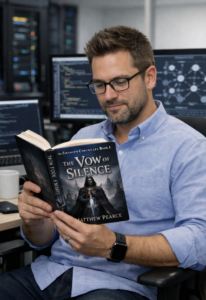
IT consultants spend their days inside complexity. They walk into organizations full of competing priorities, aging systems, hidden politics, tight budgets, fragile trust, and big expectations. They are asked to see clearly, speak carefully, and guide people through change without losing sight of risk. That is exactly why The Sinsworn Chronicles, Book I: The Vow of Silence works so well for this audience. The novel is presented as a story of prophecy, flame, redemption, and a silent exile named Elaran moving through the ashes of a fallen kingdom, joined by other wounded, complicated companions. For professionals in Information technology consulting, that kind of story is not just entertainment. It is a mirror held up to the emotional, strategic, and ethical pressure that defines real consulting work. Among the strongest fantasy novels for adults, this one feels especially relevant because it understands that the hardest battles are rarely just technical.
The Best IT Consultants Think in Systems, Not Silos
One reason this book fits IT consultants so well is that fantasy, at its best, teaches systems thinking. In The Vow of Silence, the world is shaped by prophecy, sacred rites, political power, hidden truth, and the consequences of old sins that refuse to stay buried. That kind of layered world-building matters because consultants do not work in isolated tasks. They work in ecosystems. A cloud migration affects security. Security affects compliance. Compliance affects leadership timelines. Leadership timelines affect user adoption. User adoption affects whether the whole initiative succeeds or becomes another expensive lesson. That way of seeing the world as an interconnected web is exactly what strong fantasy can sharpen.
That mindset is especially valuable right now. Gartner’s 2026 IT spending forecast says worldwide IT spending is expected to reach $6.15 trillion in 2026, while Reuters’ report on Oracle’s shift toward agentic apps shows how quickly enterprise software is being reshaped around AI-driven workflows and automation. In other words, the environments consultants advise in are becoming even more connected, more dynamic, and more consequential. A novel built around cause and effect, burden and consequence, prepares the mind to think beyond the obvious fix and toward the whole chain of impact.
Silence, Listening, and the Discipline to Diagnose Before Speaking
The title alone should catch the attention of any consultant: The Vow of Silence. That is not just a dramatic fantasy phrase. It is a reminder that power does not always begin with speaking. Often, it begins with restraint. Elaran is described as a prince stripped of his voice by sacred rite, a man carrying both prophecy and consequence. That image lands because many consultants make their biggest difference not when they talk the most, but when they listen the best. The consultants clients remember are usually the ones who hear what was not said in the kickoff meeting, catch the fear behind a stakeholder objection, and recognize when a technical request is really a trust problem wearing a software mask.
That lesson matters in a field where people are often hired for answers and then quietly judged on their judgment. The consultant who rushes in with jargon can sound smart for a moment and still miss the real issue. The consultant who listens deeply earns the right to lead. This book’s central image of silence, vow, and burden gives IT consultants something rare: a narrative reminder that not every form of strength is loud. In an industry addicted to hot takes, instant recommendations, and polished decks, that is a healthy corrective.
Complex Stakeholders, Hidden Agendas, and Pressure From Every Side
Another reason the novel fits IT consultants is that it appears to understand the weight of human tension. The book description introduces not just Elaran, but also a haunted orphan girl, a rogue cursed by what he steals, and a monk hunted for forbidden truths. Add in a tightening Church, inquisitors, relics, and prophecy, and you have a story driven by competing loyalties, moral ambiguity, and dangerous information. That sounds dramatic because it is, but it also sounds familiar to anyone who has ever managed an enterprise transformation where finance wants one thing, operations wants another, security wants caution, leadership wants speed, and no one fully agrees on what success should cost.
That tension is not theoretical in 2026. CIO’s look at the challenges IT leaders will face in 2026 highlights the pressure to balance agility with cost discipline and to move AI from hype to practical value. At the same time, McKinsey’s 2025 State of AI survey found that while AI use is broadening, many organizations still struggle to move from pilots to scaled results. That is the consultant’s battlefield: not a clean world of easy wins, but a messy world of partial truths, uneven readiness, and high expectations. A novel like this is useful because it trains readers to stay mentally engaged when motives collide and the path forward is morally or strategically complicated.
Good Consultants Respect Power, Risk, and Unintended Consequences
Fantasy becomes meaningful to working professionals when it understands consequence, and The Vow of Silence seems built around that idea. The description points to awakened relics, sharpening visions, spreading corruption, and the frightening possibility that the fire at the center of the story does not burn only the guilty. That is a powerful image for anyone advising on modern technology. Consultants know that tools with real power also come with risk, side effects, and governance questions. A new AI workflow can improve productivity and still expose sensitive data. A clever automation can save time and still break accountability. A fast rollout can please leadership and still hurt the people who have to live inside the new process every day.
That is why the current industry conversation matters so much. NIST’s AI Agent Standards Initiative was launched to help ensure AI agents are secure and interoperable, and NIST’s recent cybersecurity work on AI also emphasizes mitigating risks while organizations adopt and deploy these systems. For IT consultants, that means technical skill is no longer enough on its own. Judgment, stewardship, and disciplined skepticism matter just as much. Reading a novel that dramatizes the cost of mishandled power can sharpen those instincts in a way a white paper rarely does.
Fantasy Strengthens Strategic Imagination
There is also a simpler reason this book is a strong fit for IT consultants: it exercises imagination in a productive way. Not imagination as escape from work, but imagination as preparation for better work. Consultants are constantly asked to see around corners. They need to picture what a business could become, what a team may resist, what a hidden dependency could break, and what kind of future the client is actually trying to build. Fantasy stretches that muscle. It rewards pattern recognition, emotional intelligence, symbolic thinking, and long-view reasoning. Those are not soft extras. They are part of what separates a tactical technician from a trusted advisor. ✨
That broader skill set is becoming more important, not less. The World Economic Forum’s Future of Jobs Report 2025 says technology-related roles are expected to be among the fastest-growing through 2030, and the surrounding conversation increasingly centers on adaptation, capability building, and applied intelligence rather than narrow technical knowledge alone. Consultants who read only implementation guides may stay informed, but consultants who also read stories about burden, loyalty, sacrifice, and transformation often grow more perceptive. They become better at understanding the humans inside the system, not just the system itself.
Why This Particular Book Lands So Well for IT Consultants
What makes The Vow of Silence especially effective is that its core themes line up with the internal reality of consulting work. This is not just a book about magic or battles. It is presented as a story of broken faith, reluctant fellowship, prophecy, mercy, blood, and redemption. Those are weighty themes, and they resonate because IT consultants often live in the space between what is broken and what could still be restored. They enter organizations where trust is damaged, where previous initiatives failed, where legacy systems still shape behavior, and where people want hope but do not want another empty promise. A story that takes wounds seriously and still moves toward light is going to hit home for readers who solve problems for a living without becoming cynical.
The comparison point on the book’s page also matters. It is positioned for readers who enjoy authors like Patrick Rothfuss, J.K. Rowling, and Tad Williams, which signals a blend of emotional depth, world-building, and epic momentum. For IT consultants, that combination works because their best reading is often not the reading that simply repeats their workday back to them. It is the reading that restores scale. It reminds them that pressure, politics, and uncertainty are not reasons to shut down. They are reasons to become steadier, wiser, and more humane. That is what a good consultant brings into the room, and it is also what a strong fantasy novel can feed.
Conclusion
IT consultants operate in a time of rising spend, rising expectations, accelerating AI adoption, tighter governance demands, and constant pressure to deliver outcomes that are both practical and responsible. That is why The Sinsworn Chronicles, Book I: The Vow of Silence is such a smart read for them. It speaks the language of consequence, complexity, patience, burden, and belief. It offers not just entertainment, but perspective. And perspective is one of the most valuable assets a consultant can have. In a profession where people are hired to guide others through uncertainty, a story about a silent exile carrying prophecy through the ruins of a damaged world feels surprisingly relevant. It reminds readers that wisdom is not noise, leadership is not ego, and the strongest people in the room are often the ones who have learned how to carry fire without being consumed by it.